Beyond Sustainability… Regenerative, Restorative Tourism

While I am committed to promoting sustainability in tourism, I am sure that we can do better.
Sure – I know many destinations are struggling just to ensure that tourism is not a destructive force in their communities.But just not being bad isn’t good enough… I believe we should set the bar higher.
I am happy to say that some thought leaders in other fields are showing the way. I recently attended a presentation that highlighted the work of Bill Reed. Bill is one of the drivers behind the hugely influential LEED program. He has taken the next step – beyond sustainability- and committed himself to work that not only doesn’t harm the environment – but contributes to environmental regeneration. As it says on his website “Ultimately, his objective is to improve the overall quality of the physical, social and spiritual life of our living places”.

Tourism can be part of that future – a future that is not only sustainable – but restorative and regenerative.

Leading by Example – Surf City USA

Surf City USA really gets sustainable tourism. The folks at Visit Huntington Beach realized that their long term success meant protecting the environment, and celebrating the culture of the iconic SoCal Surf City while ensuring the visitor economy remained vibrant.

In other words – they recognized the importance of sustainable tourism and took

an active role in promoting within the

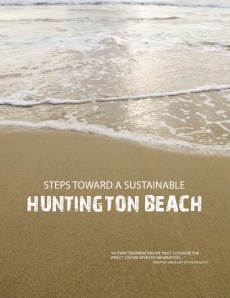
Huntington Beach Report

destination.

To support industry and community adoption of sustainable tourism they produced some great materials that explain sustainability and provide action tips to visitors, business owners and the community. To get the sustainability guide click through here. Its worth the read !

Connecting Dots

One of the real challenges in creating change for sustainable tourism is creating meaningful support for practitioners. We know what needs to be done – but it is hard to do. Seth Godin’s Blog “How to Draw an Owl” captures the problem perfectly. Its easy to draw the two circles that form the basic structure of the owl – but the challenge is in drawing the rest of the damn owl….

Great Green Talent Machine ? But how do I get the job ?

Bain and Company, one of the world’s leading consultancy companies, recently released their report – “Great Green Talent Machine” touting the importance of CSR in recruiting talent. This is the latest in a series of articles and papers highlighting the importance of corporate reputation and values, often best expressed through their CSR activities, as a factor in attracting talent.

So what if you are the “talent”? You are attracted to the company and now you want to work with them. How do you get the job ? What do recruiters from these companies look for ?

As a college professor I know this question is particularly important for recent grads trying to establish themselves in new careers. Fortunately, recent research gives some answers to this important question. In a recent study conducted with Aini Karani, we asked college recruiters from hospitality companies whether they felt CSR was an important factor in recruiting college students. Corporate Reputation was the top reason they listed. CSR ranked 10th in things that recruiters felt attracted students to want to join their company. Interestingly – salary was ranked 13th !

Then we asked what they looked for in new recruits. The results reinforced the importance of attitude, team orientation and communications skills. The study showed that recruiters pay little attention to specific activities but that they are influenced by what they perceive to be  the values of the potential recruit.

The full study is published in Journal of Human Resources in Hospitality and Tourism – “Corporate Social Responsibility and College Recruiting in the Hospitality Industry” 

Getting Out and Experiencing Nature

I love getting out into nature. It refreshes and invigorates me. Many of my favorite memories include visits to national parks – in both Australia and the US.  My love of nature also inspires my concern for sustainability.

So – I worry that fewer people are visiting national parks and natural places. It isn’t surprising – most camping experiences are really only appealing to a relatively small group of people. Most camp grounds I’ve been to have basic facilities at best ( and filthy disgusting facilities at worst), require campers to have their own equipment and expect visitors to be “in the know” about camping. Those can be pretty big barriers to entry.

The time has come for new ways of thinking about the facilities and services we provide to allow people to experience the nature. There are large groups of people who want to experience the outdoors but don’t want to be uncomfortable doing it. Let’s find ways to satisfy their needs and get them outdoors.

Some folks will say it is good that visitation is dropping off – it means less people are out “wrecking”  natural places. I worry about the sustainability of that position. If people don’t experience these places they won’t value them with the same intensity. It is one thing to know “academically” that National Parks are a good thing, it is another to have lived it.

Perhaps purists will say that I am wrong in suggesting that “one size never fits all” and that if people want to experience outdoors they must get dirty. My response – why ? Sure – I love getting dirty and away from the crowds – but that doesn’t mean everyone has to do it the way my way. Expecting that everyone will be happy with the same product offering is the problem.

Of course – wherever there is a problem, there is opportunity. And already some entrepreneurs are starting to offer new products. Indeed,  as is often the case, the pendulum has swung to the other extreme. USA Today recently included an article on “glamping”, the “new” trend of glamour camping complete with butlers and chefs.   While this isn’t exactly my cup of tea I do applaud these entrepreneurs who are seeking ways to get new groups of people to experience (and develop a love of) nature.  Between glamping and the average campground there must be many new ways of providing visitors more satisfying experiences of nature…. and its important we get it right for nature’s sake. 

The Right Message Matters…

Most destinations marketers are familiar with the principles of target marketing. Targeting the right message to move a specific group of consumers through the buying process is standard operating practice at most DMOs.

It is surprising how few DMOs use the same principles of targeting their message to specific groups within the destination. Often the communication with these stakeholder groups is “one size fits all”. Of course, “one size fits all” normally means that no one is getting what they need.

This point was made clear to me during a recent research project led by my colleague, Dr. Mick La Lopa. In this project we examined the adoption of sustainable tourism practices in a specific destination and the results were clear. There were three distinct groups within the businesses we surveyed: one group that was “on the fence” and needed specific suggestions and assistance to get things moving, one segment that was “on board” and needed support and encouragement and a final group that wasn’t thinking about sustainability and needed to be introduced to the concept and convinced of its importance.  The strategies needed to support these three groups are very different – one size does not fit all.

As DMOs grapple with their role in product development “internal marketing” is becoming more important. Targeting the message to the folks at home is just as important as targeting the message to consumers.


Want to read the article?

La Lopa, J., & Day, J. (2011). Pilot study to assess the readiness of the tourism industry in Wales to change to sustainable tourism business practices. Journal of Hospitality and Tourism Management, 18, 130–139. DOI 10.1375/jhtm.18.1.130

Corporate Social Responsibility in China’s Hospitality Industry.

Corporate Social Responsibility (CSR) is one of the key drivers of sustainable tourism. The tourism system involves many actors all working to deliver a customer experience. There is little in the way of “top down, command and control” in tourism.  So – without the active participation of companies – and the managers that run those companies – it is difficult to imagine the tourism system becoming more sustainable.

In a recent study led by Diana Chan Yu, we examined the drivers of Corporate Social Responsibility in hotels in China. A couple of findings stood out to me:

  • Confucianism and commitments to a Harmonious Society provide a solid foundation for CSR in China.
  • CSR often starts close to home – with stakeholders that are critical to the company’s operation. Many CSR activities involve staff members and the local community.
  • Finally, while many hoteliers don’t necessarily call their activities “CSR or Corporate Social Responsibility” they actively engage in CSR activities – from supporting local environmental initiatives to supporting staff (beyond the letter of the law).

To see the full study – click here.

Video

Cleaner aviation for more sustainable tourism

http://www.boeing.com/stories/videos/vid_17_ecodemonstrator.html

Air travel is the biggest single contributor to Greenhouse Gases in the tourism system. Airplane manufacturers work to reduce emissions even as demand for new plans increases. Nice to see some progress

Voluntourism in the mainstream

Flipping through the pages of most high end consumer travel magazines – Travel and Leisure, Conde Nast Travel and the like – exposes the curious to some of the most luxurious brands on the planet. These magazines are the showcases for some of today’s most upmarket consumer brands and the content of the magazines – both the editorial and the advertising – reflect the interests of these affluent readers. At first glance- it may seem that these interests are exclusively self centered but a closer examination shows that issues of sustainability and responsible tourism are receiving increasing coverage.

Voluntourism – where visitors volunteer for charities and NGOs in the destination – has been an important trend in recent years . It is great to see Conde Nast Traveler’s Dorinda Elliott covering voluntourism in a recent edition. I particularly like that Dorinda article recognizes the challenges of voluntourism.

I am a strong believer that most acts of charity do more good than harm. Nevertheless  unintended consequences – even when the motives are pure – need to be carefully considered. Dorinda follows her main article with an empowering sidebar of recommendations for people considering spending part their vacation helping others. Bravo !

Growing Up

I remember the conversation vividly. We were driving to University, making small talk and the question came up “when do you know you are an adult?” I was pretty sure I felt adult at the time … not so my friend who pushed the line a few years beyond where we currently sat – somewhere around 23 or so….

As early Gen Xs we were just starting to explore a set of opinions that differentiates us – and the generation of Millennials who followed us – from older generations. That is – that adulthood comes late. Today, many Millennials would answer the question – when am I an adult – with a number around 30. An interesting article in USA Today captures the trend nicely.

There are many reasons why we are moving the strating line of adulthood further down the track. Knowing that it is happening is important.